
Day: November 1, 2026

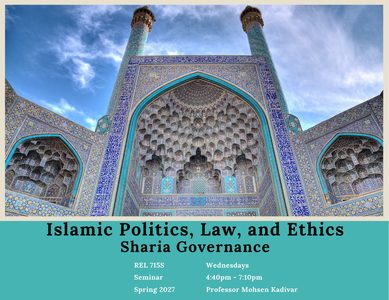
Islamic Politics, Law, and Ethics

This course explores the multifaceted relationship between Islam and politics, specifically examining the intersections of Sharia, ethics, jurisprudence, law, theology, and philosophy. Central to our inquiry is a critical analysis of Sharia Governance. The curriculum draws a clear distinction between “Islamic political ethics,” the institutionalized structures of “Islamic constitutional law,” and political science. By tracing the genealogy of these concepts from the premodern to the modern era through the sources, students will critically evaluate the evolution of “Political Islam,” “the Islamic political system,” and the contemporary notion of “Islamic government.”
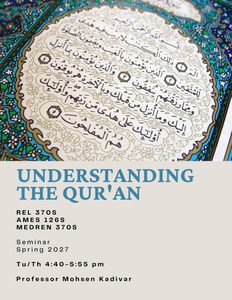
Understanding the Qur’an

This course explores the history of revelation, or the words of God in Islam; the formation of the Qur’an as a book; its interpretation from medieval to modern times; its major themes; and how the Qur’an introduces itself: the book of light, guidance, virtues, and values. Teaching the Qur’an as religious literature from a neutral viewpoint that could be understood from a secular or non-theological perspective; the lessons one might apply from literary criticism, biblical studies, and historical methodology; and its message for human beings in the contemporary world.

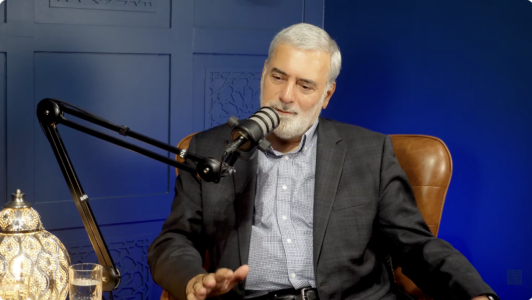
Is “Islamic State” Islamic?

Islam offers lasting political principles, but no fixed political ideology, and every attempt at an Islamic state has ended up secularizing itself. Politics is the knowledge of power and its limits, and it is secular in its essence, since a ruler in a nation-state must serve the public interest of everyone, not only believers. Fusing religion and politics turns faith into a tool of power. Secularism separates religious institutions from the state, not religion from politics. The conversation then turns to dār al-islām and dār al-ḥarb, armed resistance and terrorism.