Tag: political Islam

Religion and Politics In Post-Revolutionary Iran

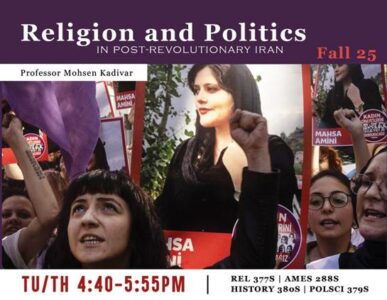
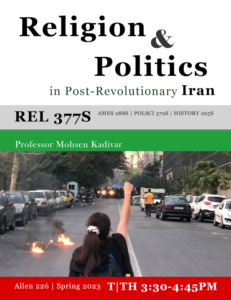
This course will narrate a fair and balanced critical and historical analysis, and is organized into five thematic sections: a brief overview of the relationship between religion and politics in Iran, an intellectual history of the Islamic Republic, examining the concept of the “sacred as secular” and exploring the dynamics of secularization within a theocratic system, the governance in the name of Islam, focusing on theology and theocratic rule in the Islamic Republic, and the revolt against theocracy: the Mahsa Movement and the feminist uprising against theocracy in Iran.

Religion and Politics in Post-Revolutionary Iran

What is the relationship between religion and politics in general and Islam and politics in particular? What does ‘political Islam’ or ‘Islamism mean’? What was Khomeini’s political thought? What does theocracy do with secularism and democracy? What is the role of election in a quasi-democratic regime? How did regime expediency secularize the administration? What is the relationship between civil law and Islamic law (sharia)? Why did the Islamic Republic of Iran transform from a competitive electoral to a non-competitive electoral authoritarian regime?

Islamic Political Philosophy after 40 years

Khomeini’s political theory of the absolute appointive guardianship of the jurist council was based on several problematic prerequisites or hypotheses: 1) The teachings of Islam could not be practiced completely unless political power was held by the jurists. 2) The establishment of an Islamic State as the necessary premise of implementing Shari’a. 3) Shari’a as Islamic law as state law. 4) Jurist ruler can make any law or suspend any law including Shari’a rulings for the purpose of public interest or regime protection. It is absolutely wrong theoretically and practically.