

Islamic Perspectives on Prophecy and Revelation
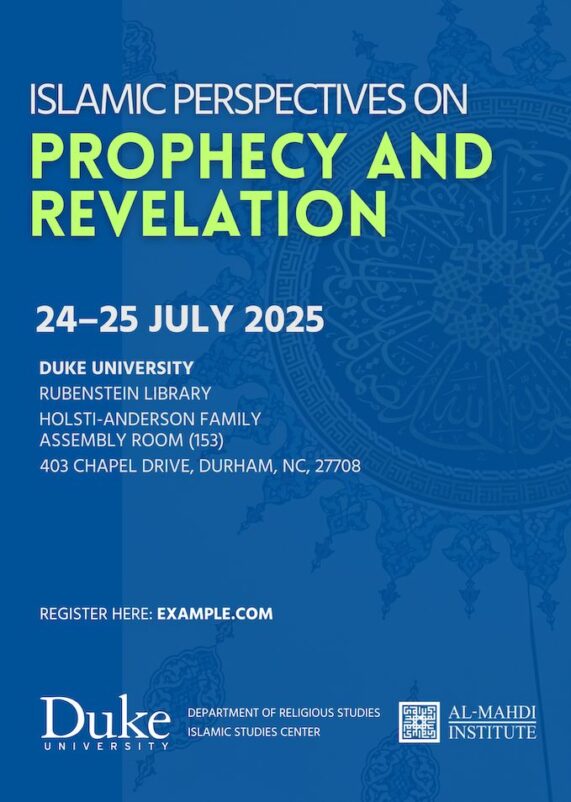
AMI’s Department of Islamic Philosophy and Theology, together with the Department of Religious Studies and Duke Islamic Studies Centre at Duke University, is delighted to open registration for its second international conference on ‘Islamic Perspectives on Prophecy and Revelation.’ The conference, convened by Dr Wahid Amin and Prof. Mohsen Kadivar, will be held over two days, from 24th to 25th July 2025 at Duke University, Rubenstein Library, Holsti-Anderson Family Assembly Room (153), 403 Chapel Drive, Durham, NC, 27708.
Together with the belief that there is only one God and that life here and now is a mere prelude to an eternal afterlife, the belief in prophecy is regarded as one of the fundamental tenets of Islam. Indeed, it is through the revelatory experiences of Muḥammad, as compiled and preserved in the Quran, that Muslims derive the fundamental articles of faith concerning the nature of God, the afterlife, the resurrection, and notions such as heaven and hell. Prophecy and revelation thus constitute the principal epistemological foundation of Islam. However, unlike other doctrinal issues like God and His attributes, monotheism, and the salvation of non-Muslims, the phenomenon of prophecy in Islam has not been sufficiently problematized or discussed in secondary literature in Western languages. This conference aims to shift the focus and methodology of studying prophecy in Islam from the historical study of the Prophet Muḥammad to the phenomenon of prophecy itself, thereby directing attention to the vast body of literature in Islam that investigates the philosophical dimensions of prophecy across different Islamic disciplines.
The Prophet was both the recipient of a personal revelation and the primary interpreter of that revelation’s contents. His experiences and subsequent teaching constitute one of, if not the main, sources of religious knowledge for Muslims. In Islamic philosophy, Muslim thinkers such as al-Fārābī, Avicenna, Suhrawardi, Averroes, and Mullā Ṣadrā argued for the necessity of prophecy in a multitude of ways, some of which are based on Platonic, Aristotelian, and Neoplatonic philosophical frameworks. The Islamic philosophical tradition, for example, contains extensive material on the nature of the rational soul and the existence of a so-called “holy faculty” (al-quwwa al-qudsiyya) that enables prophets to receive divine communication and perform miracles. Islamic philosophers also discussed the language of revelation extensively in disciplines such as logic and rhetoric, sometimes leading to controversial claims such as the view that the language of scripture was merely intended for the general masses and that the real, non-figurative meaning of these revelations could only be pursued through philosophy. Many of these topics were also discussed in the theological traditions of Islam. One topic in particular that had grave political consequences and was hotly contested by different Muslim factions was the question of whether or not the Quran, as the Word of God, is pre-eternal or created. The modality of God’s speech sparked passionate debates. In uṣūl al-fiqh,numerous discussions were undertaken concerning prophecy and revelation which today would be considered as topics within philosophy of language, philosophy of religion, theology, ethics, and epistemology. In the modern period, contemporary scholars of Islam have challenged traditional concepts and theories of prophecy by placing greater emphasis on the Prophet’s own subjectivity and contextual setting thereby challenging previously held notions about how revelation and scripture ought to be interpreted. To achieve a more holistic and nuanced understanding of prophecy in Islam, therefore, this conference explores the philosophical issues surrounding prophecy and revelation as these have been discussed in various Islamic disciplines.
The topic of prophecy and revelation in Islam is also of profound importance for modern people, particularly in an era where the relevance and interpretation of religious experiences are frequently questioned. This conference will address contemporary challenges and objections to the concepts of prophecy and revelation, particularly within the philosophy of religion. By engaging with modern critiques and philosophical dilemmas, the conference aims to provide deeper insights and responses to these issues, reaffirming the significance of prophetic experiences in a rapidly changing world. This dialogue is crucial for fostering a nuanced understanding of how these ancient concepts can be meaningfully integrated into modern thought and practice, helping to bridge the gap between traditional beliefs and contemporary intellectual concerns.
Applicants are invited to consider the proposals in the following areas:
- The Nature and Function of Prophecy in Islamic Thought
- The Nature and Function of Revelation in Islamic Thought
- Prophecy, Revelation, and Epistemology
- Prophecy, Revelation, and Philosophy of Language
- Prophecy, Revelation, and Philosophy of Religion
- Revelation, Unseen World, and Skeptical Theology
- Prophecy, Revelation, and Comparative Abrahamic Traditions
- Contemporary Issues and Challenges to Prophecy and Revelation
Conference Program
The full conference schedule can be viewed here.
Registration Details
Click here to register to attend the conference at Duke University.
Registration is free and includes breakfast and lunch on both days.
Publication
The conference proceedings will be published by AMI Press, ensuring that the valuable insights and discussions from the event are accessible to a broader audience. The edited volume will be a collaborative effort, jointly edited by Professor Mohsen Kadivar and Dr. Wahid M. Amin. This publication will serve as a significant scholarly contribution, encapsulating the diverse perspectives and critical analyses presented during the conference and furthering academic discourse on the themes of prophecy and revelation in Islam.