
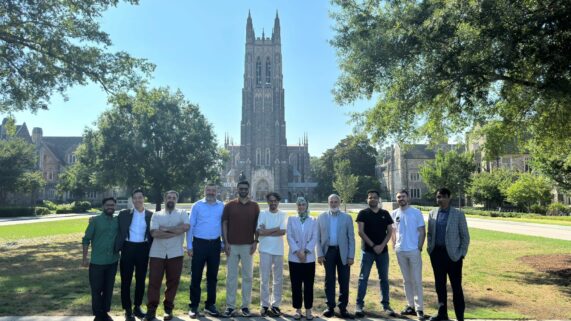
The Department of Islamic Philosophy and Theology at the Al-Mahdi Institute (AMI) in Birmingham, UK, in collaboration with the Department of Religious Studies and the Duke Islamic Studies Center at Duke University, held its international conference titled “Islamic Perspectives on Prophecy and Revelation” on July 24–25, 2025 at the Rubenstein Library of Duke University. Dr. Wahid Amin (AMI) and Professor Mohsen Kadivar (Duke) organized the event.

Scholars were invited to present their research on the following topics:
• The nature and function of prophecy in Islamic thought
• The nature and function of revelation in Islamic thought
• Prophecy, revelation, and epistemology
• Prophecy, revelation, and philosophy of language
• Prophecy, revelation, and philosophy of religion
• Revelation, the unseen realm, and skeptical theology
• Prophecy, revelation, and comparative studies of the Abrahamic traditions
• Contemporary issues and challenges to prophecy and revelation
Conference Program
The full conference schedule can be viewed here.
Thursday, July 24, 2025
11:15 – 11:30 | Dr. Wahid M. Amin: Opening Remarks
Panel One | 11:30 – 12:30
• Dr. Muhammad Fariduddin Attar (Carleton University): Ghazālī and Rāzī on Miracles and the Occult
• Dr. Nazir Khan (University of Nottingham): Ibn Taymiyyah’s Epistemology of Prophethood and Miracles
Panel Two | 14:00 – 15:00
• Professor Mahmoud Morvarid (Institute for Research in Fundamental Sciences, Tehran): The Veridicality of Prophetic Perceptual Experiences: A New Proposal
• Dr. Halim Calis (Respect Graduate School): From Unity to Multiplicity: Divine Speech, Revelation, and Prophethood in Ibn ʿArabī’s Thought
Panel Three | 15:30 – 16:30
• Dr. Jamie Turner (University of Birmingham): Where Falsafa Meets Analytic Philosophy of Religion: A Farabian-Hickian View of Prophecy
• Professor Imran Ejaz (University of Michigan–Dearborn): Hume’s “Of Miracles,” Islam, and Prophetic Revelation
Friday, July 25, 2025
Panel Four | 11:00 – 12:30
• Professor Arash Naraghi (Moravian University): Fazlur Rahman’s Approach to Qur’anic Revelation: A Psychological Dimension
• Professor Mohsen Kadivar (Duke University): Toward an Islamic Model of Revelation
• Dr. Amir Saeemi (Independent Researcher): The Moral Function of Revelation in an Age of Reason
Panel Five | 14:00 – 15:00
• Dr. Wahid M. Amin (Al-Mahdi Institute): The Qur’an as Divine Speech: Shīʿī Uṣūlī Thought and Speech Act Theory
• Shaykh Arif Abdul Hussain (Al-Mahdi Institute): An Inter-Quranic Contextual Analysis of the Nature of Revelation and the Revealer
Panel Six | 15:30 – 16:30
• Dr. Seyed Amir Asghari (Baylor University): Prophetic Wisdom in the Quran: Bridging Divine Revelation and Universal Ethical Principles
• Dr. Celene Ibrahim (Groton School): Ameliorating Gender Bias in Muslim Prophetology
16:30 – 17:00 | Professor Mohsen Kadivar: Closing Remarks

It is worth noting that the conference, focused on a unique and timely topic, was successfully held at Duke University and was received well by the academic community. Unfortunately, the event was affected by increasingly restrictive U.S. visa policies under the current U.S. administration. As a result, several invited speakers were unable to attend; three delivered their presentations virtually, and some chose not to participate. Undoubtedly, in the absence of these limitations, the conference would have been even richer in content. Nonetheless, the event proved to be a valuable and innovative experience. In addition to the scholarly presentations, the lively and in-depth discussions following each session were particularly fruitful and rewarding. Most importantly, the very act of organizing a conference on one of the most fundamental Islamic topics—prophecy and revelation—at a leading American university during this challenging period in the United States constitutes a significant achievement.

Publication
The papers presented at the conference will be published by AMI Press, ensuring that the ideas and discussions of this event reach a wider audience. The volume will be co-edited by Professor Mohsen Kadivar and Dr. Wahid Amin.
