
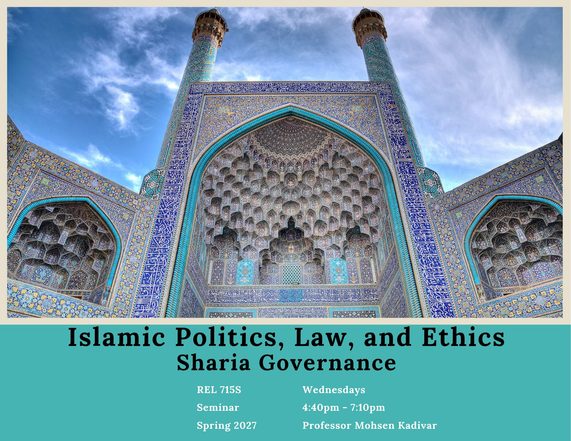
RELIGION 715S
Islamic Politics, Law, and Ethics:
Sharia Governance (al-Siyāsa al-Sharʿiyya)
Seminar
Spring 2027
Wed 4:40–7:10 pm
Mohsen Kadivar, Ph.D.
Course Description
This course explores the multifaceted relationship between Islam and politics, examining the intersections of Sharia, ethics, jurisprudence (fiqh), law, theology (Kalām), and philosophy. Central to our inquiry is a critical analysis of Sharia Governance (al-Siyāsa al-Sharʿiyya). The curriculum distinguishes among “Islamic political ethics,” the institutionalized structures of “Islamic constitutional law,” and political science. By tracing the genealogy of these concepts from the premodern to the modern era through primary sources, students will critically evaluate the evolution of “Political Islam,” “the Islamic political system,” and the contemporary notion of “Islamic government.”
The relationship between Islam and politics can be examined through at least three major approaches: philosophical, theological-jurisprudential, and advisory (discourse addressed to rulers, or “counsel for kings”). Al-Fārābī initiated the philosophical approach, Avicenna continued it, and other Muslim philosophers developed it further. It constitutes the third branch of practical philosophy, namely the “politics of cities,” and represents an Islamic engagement with the Platonic and Aristotelian traditions of political philosophy.
The advisory approach is represented by the genre known as Naṣīḥat al-Mulūk (Counsel for Kings), which is grounded in al-āthār and al-ādāb. This genre offers moral and political counsel to rulers without institutional or practical guarantees, and one of its most famous examples is al-Ghazālī’s Naṣīḥat al-Mulūk. Historically, both the philosophical and advisory approaches have remained marginal within the broader landscape of Islamic political thought.
The primary focus of this course is the second and most influential approach: the theological and jurisprudential tradition of Islamic political thought. Its major classical works are known as al-Aḥkām al-Sulṭāniyya (The Ordinances of Government) and al-Siyāsa al-Sharʿiyya (Sharia Governance), authored by al-Māwardī and Ibn Taymiyya, respectively. In the modern period, this tradition is represented by thinkers such as Rashīd Riḍā, Abū al-Aʿlā al-Mawdūdī, and Ruhollah Khomeini.
After tracing the genealogy of Islamic political thought in the premodern era, the course turns to its modern transformations, objectives, and challenges. Particular emphasis is placed on Islamic political ethics, the derivation of its universal moral principles, and a critical analysis of Islamic political jurisprudence and law. Given the inherent temporal and spatial limitations of legal codes and juridical systems, the construction of a “religious constitutional law” or a “religious political science” is argued to be both conceptually untenable and practically harmful. Likewise, generalizing political practices from early Islamic history into permanent, fixed rules for Islamic constitutional law or political science is methodologically flawed and contrary to established scholarly standards.
On this basis, the course critically examines and ultimately rejects notions such as Islamic constitutional law, Islamic political science, Political Islam, Islamic government, political jurisprudence (al-fiqh al-siyāsī), the political guardianship of the jurist (wilāyat al-faqīh), clerical supervision, and the model of the Islamic Republic. This rejection, however, does not entail political withdrawal or passivity. Rather, it seeks to liberate Islam from instrumental political use, not to invite political surrender. Muslims, like all citizens, participate in political life within civil society while maintaining their religious identity. Commitment to Islamic ethical principles, especially those governing justice, opposition to oppression, and fidelity to social contracts, can in fact provide a stronger moral foundation for responsible and principled political engagement.