Tag: freedom

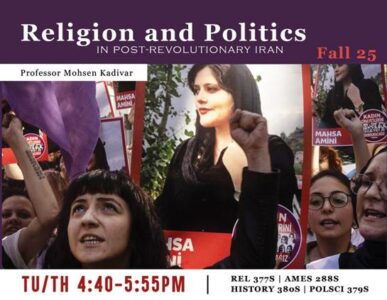
Religion and Politics In Post-Revolutionary Iran

This course will narrate a fair and balanced critical and historical analysis, and is organized into five thematic sections: a brief overview of the relationship between religion and politics in Iran, an intellectual history of the Islamic Republic, examining the concept of the “sacred as secular” and exploring the dynamics of secularization within a theocratic system, the governance in the name of Islam, focusing on theology and theocratic rule in the Islamic Republic, and the revolt against theocracy: the Mahsa Movement and the feminist uprising against theocracy in Iran.

Statement on Palestine

The atrocities we have witnessed on and after October 7th did not happen in a vacuum. We condemn the brutal and inhumane attacks against civilian lives and call for an immediate ceasefire. The situation is a crime against humanity and an ethnic cleansing. The Duke University Faculty for Justice stands in solidarity with those fighting for anti-colonial liberation, including the freedom struggle in Palestine. Over two million people, nearly half of whom are children, have been entrapped in an open-air prison, given very little freedom of movement in and out.

In support of Protests in Iran

This is the fourth big protest since 2019 in Iran. Iranians are outraged with grievances that won’t soon go away. This is not only about freedom for women (especially their hair covering), but freedom for the country from the ruling of the minority over the majority, freedom of a style of life, against the mandatory style of life. The majority of Iranians support a democratic, secular regime. The government blocked all the ways of reforms. There’s no way for the people, except to come to the streets and protest.

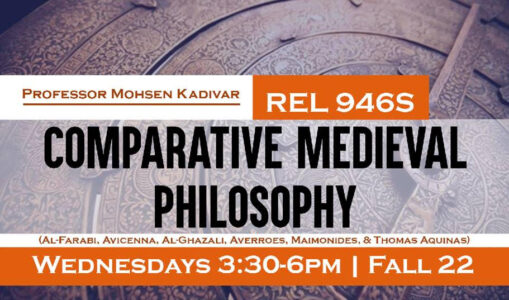
Comparative Medieval Philosophy

Medieval philosophy is a prerequisite to understanding the theology of Abrahamic traditions, metaphysics, philosophical psychology, and political philosophy. We will focus on six top philosophers: Alfarabi, Avicenna, al-Ghazali, Averroes, Maimonides, and Thomas Aquinas. After discussing general information about two translation movements, these distinguished philosophers, their works, and their philosophical innovations through the translation of a few of their major works, we will focus on comparative studies on three important subjects: God, creation, and freedom in three Abrahamic traditions, focusing on Avicenna, Averroes, Maimonides, and Aquinas in detail.