

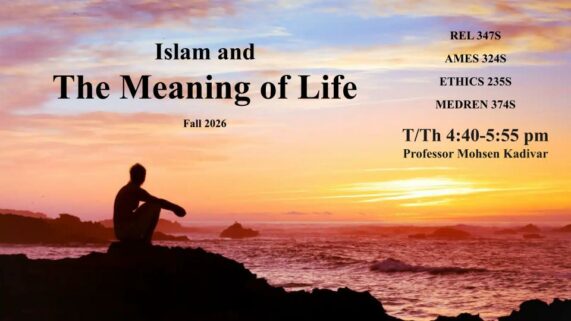
RELIGION 374S, AMES 324S, ETHICS 235S, MEDREN 374S
Islam & The Meaning of Life
Seminar
Fall 2026
Tue/Thu 4:40-5:55 pm
Mohsen Kadivar, Ph.D.
Course Description
What makes life meaningful? Why are we here? Is happiness enough to give life purpose, or does meaning require something deeper? Is death the end of human existence, or does human life continue beyond physical death? Do moral values have an objective foundation, and if so, where do they come from? These enduring questions have challenged philosophers, theologians, and scientists across cultures and centuries.
This course explores the question of the meaning of life through the lens of Islamic thought while situating it within broader philosophical and religious debates. We begin by examining three major approaches that have historically attempted to answer these questions: monotheism (and other forms of supernaturalism), naturalism, and nihilism (or pessimism). Each perspective offers a distinctive account of human purpose, happiness, morality, and the ultimate fate of human beings.
Within the Abrahamic traditions, the meaning of life is deeply connected to a God-centered vision of reality. In this framework, the deepest aspirations of human nature—such as the longing for truth, justice, beauty, love, and eternal significance—are fulfilled through a relationship with God. Human beings are understood to possess a soul that is united with the body during earthly life but continues beyond physical death. From this perspective, the meaning of life cannot be reduced to material success or physical existence alone.
After introducing the broader philosophical discussion, the course focuses on the Islamic understanding of life’s meaning. It examines both the shared foundations and the distinctive contributions of Islam within the Abrahamic tradition, comparing Islamic perspectives with those found in Judaism and Christianity. Particular attention is given to how Islamic teachings address central human concerns such as happiness and the good life, moral responsibility, freedom and purpose, human dignity, the search for truth, the experience of suffering, and the longing for transcendence.
Students will explore how Islamic thought engages questions such as: What is the ultimate purpose of human existence? What is true happiness? How can human beings overcome alienation and find inner peace? How are faith and reason related in the search for meaning? What grounds moral obligations, justice, and human dignity? And how does belief in God shape the understanding of human destiny?
The course approaches these questions from three complementary perspectives within Islamic intellectual tradition:
- The Qur’anic perspective, which presents the foundational scriptural vision of human purpose and destiny.
- The mystical perspective, particularly in Islamic spirituality (Sufism), which emphasizes inner transformation and the experiential knowledge of God.
- The philosophical and rational-theological perspective, which explores these questions through systematic reflection and argument.
Because the meaning of life is a central theme in the philosophy of religion, the course also introduces key developments in Islamic philosophy. After a brief historical overview, we will study the thought of two influential Muslim philosophers, Al-Farabi and Ibn Sina (Avicenna). Special attention will be given to Ibn Sina’s influential philosophical framework and its impact on Islamic, Jewish, and Christian intellectual traditions.
By combining philosophical inquiry, theological reflection, and mystical perspectives, this course invites students to engage one of humanity’s most profound questions: What does it mean to live a meaningful life? Students will gain both a deeper understanding of Islamic intellectual traditions and a broader philosophical framework for reflecting on the purpose and value of human existence.