
Iran at a Crossroads: Protests and Political Futures
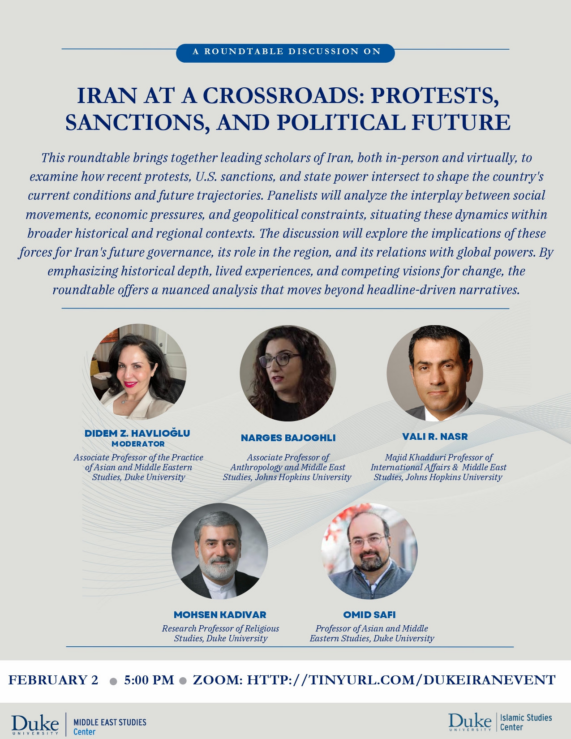
Duke Roundtable, February 2, 2026
First, I would like to thank the Duke Islamic Studies Center and Duke University Middle East Studies Center, especially Professor Mbaye Lo, as well as the panel moderator, Professor Didem Z. Havlioğlu. I am pleased to have the opportunity, alongside other colleagues, Professor Vali R. Nasr (Johns Hopkins University), Professor Narges Bajoghli (Johns Hopkins University), and Professor Omid Safi (Duke University), to engage in a critical discussion of the recent events in Iran. I extend my heartfelt condolences to the people of Iran.
On this occasion, I intend to briefly present some points regarding the political theory of the Islamic Republic and its connection to the recent bloody protests.
I
The doctrine of velāyat-e faqīh (Guardianship of the Jurist) can be examined from several perspectives: religious and jurisprudential, legal and constitutional, political philosophy and realpolitik, and its relationship to the recent protests. I will briefly address each.
Velāyat-e faqīh is a jurisprudential term referring to the guardianship exercised by a jurist over individuals without guardians in the absence of a nation-state. Its transformation into political guardianship of the jurist is no more than two centuries old. As explicitly stated by Ayatollah Seyyed Abolqasem Khoei, the majority of Shiʿi jurists do not believe in the doctrine of absolute guardianship of the jurist. Political guardianship of the jurist, as articulated by Ayatollah Khomeini, constitutes one form of political Islam or Shiʿi revolutionary fundamentalism. In Guardianship Government (1998), I have elaborated in detail the reasons for its invalidity with respect to the foundations of Islamic teachings.
The Constitutional Revolution and its 1906 Constitution sought to limit the absolute power of the monarch, transform the monarchy into a symbolic institution, and transfer the administration of the country to the people’s representatives in parliament. Unfortunately, the constitutional façade was quickly preserved while political reality reverted to absolute monarchy. The peak of constitutional government in Iran’s history was the national government of Mohammad Mossadegh, which resulted in the nationalization of the oil industry. This liberal, secular, democratic government was overthrown by the August 1953 coup orchestrated by MI6 and the CIA, and a quarter-century of dependent secular dictatorship was imposed on Iran.
The 1979 Revolution had two principal demands: independence and freedom, and, of course, justice, which was later added in the ambiguous form of “Islamic government,” understood more as just governance than anything else. Despite the charismatic personality of Ayatollah Khomeini—who enjoyed overwhelming popular acceptance —velāyat-e faqīh was never a national demand and was not even among the slogans of the revolution. It was absent from the draft constitution, too.
Nevertheless, velāyat-e faqīh entered the constitution and altered its entire structure. While national sovereignty based on elections was also recognized, the result was a hybrid legal system. Ayatollah Shariatmadari, a Shi’ite authority of equal standing with Ayatollah Khomeini, protested the constitutional referendum in December 1979 due to the contradiction between velāyat-e faqīh and the principle of national sovereignty, and he later died under house arrest. In the constitutional revision, the requirement of marjaʿiyyat (Shi’ite authority) for leadership was removed, and absolute guardianship of the jurist was added. In practice, the Islamic Republic turned into a religious dictatorship—a dictatorship that exploits Islam and Shiʿism for authoritarian purposes.
From the perspective of political philosophy, the Islamic Republic, based on absolute guardianship of the jurist, is an authoritarian electoral regime. Under Khamenei, real elections have gradually been reduced—through the Guardian Council’s approbatory supervision—to choices among candidates approved by the regime. Ayatollah Montazeri—who was intended to be the second Supreme Leader and was dismissed for protesting the unlawful execution of several thousand political prisoners in summer 1988—declared a few months before his death in 2009 that this regime is neither republican nor Islamic.
Absolute guardianship of the jurist can be described as an Islamic Leviathan: an absolute government concentrated not in the state but in the person of a jurist, ruling through a form of Machiavellianism. From another perspective, the authority of this regime—which once relied on massive popular support—now depends on the military power of the IRGC and domestically produced missiles: an intertwining of religious authoritarianism and military authoritarianism.
From the standpoint of political legitimacy, among the pillars of the 1979 Revolution, the Islamic Republic has attended only to independence. Its principal preoccupations have been the elimination of Israel and resistance to U.S. dominance in the region, for which it has paid an extremely heavy price. This struggle has overshadowed the realization of social justice—one of the system’s original goals—such that one-third of the population now lives below the poverty line. This failure is due to harsh U.S. sanctions, structural corruption, and entrenched managerial inefficiency.
Freedom has never been a concern of the Islamic Republic, and it has made minimal effort to realize it. By freedom, I focus on political freedom and freedom of lifestyle. Women’s freedom of headscarf was ultimately achieved through the mass protest movement “Woman, Life, Freedom” in 2023, at the cost of several hundred deaths, and was effectively imposed on the regime by young women and Iranian society.
Another example is the right to peaceful assembly, recognized in Article 27 of the Constitution. This fundamental principle—essential to any democratic government—has never been implemented. While supporters of the regime enjoy this right, critics of the Islamic Republic have never been allowed to hold peaceful demonstrations, and whenever they have taken to the streets, they have been suppressed by plainclothes agents, police, or security forces.
The people of Iran have tried every possible avenue to reform the Islamic Republic and have encountered only dead ends. Despite all restrictions, in presidential elections, they have managed to elect the reformist Mohammad Khatami, the centrist Hassan Rouhani, and the moderate reformist Masoud Pezeshkian, defeating hardline candidates favored by the Supreme Leader. Yet none of these three administrations was able to take fundamental steps toward reform due to constant interference by the Leader and institutions under his control.
The Islamic Republic has placed the Iranian people before two options: submission to the status quo or recourse to violent regime change through foreign intervention. While the choice of the majority lies between these two: a peaceful, non-violent transition from the Islamic Republic toward a democratic government.
Public support for the regime has declined sharply at least since 1989, and it can now be stated with confidence that the Islamic Republic has become a minority rule over a dissatisfied majority. This minority constitutes at most around fifteen percent of the population and is supported by the IRGC and the Basij militia. Electoral participation, which once stood at approximately 80 percent, has sharply declined to less than half.
II
Over the past thirty years, Iran has witnessed a major protest roughly every 2.6 years, including those of 1999, 2009, 2017, 2023, and 2026. All these largely peaceful protests were violently suppressed. The rising death toll of peaceful demonstrations signifies a severe erosion of the regime’s legitimacy.
The January 2026 protests began in Tehran’s bazaar, initially in response to currency fluctuations. Compared with the late December 2017 protests—also triggered by economic grievances, these protests represented the expression of accumulated anger over intensifying economic pressures. Bazaar protests in Iran have been highly consequential since the Constitutional Revolution. None of the other protests during the Islamic Republic began in the bazaar.
This initially economic protest quickly assumed a political character and spread to most cities across the country. As in several recent major protests, the slogans targeted the very foundations of the Islamic Republic and the person of the Supreme Leader. The people expressed their profound dissatisfaction with both the micro- and macro-policies of the regime, and with Khamenei personally, with clarity and explicitness.
For the first time, the number of demonstrators surpassed the record set during the peaceful movement of 2009. However, following the shutdown of both domestic and international internet access on Thursday, January 8, an unprecedented massacre occurred. In the absence of independent domestic media, the role of foreign-based media outlets, external calls for protest, and exhortations encouraging demonstrators to resort to violence—under the claim that “help was on the way” from a major world power’s president—had a significant impact on the unprecedented violent turn of these protests. These promises were never fulfilled, and these calls effectively sent defenseless protesters to their deaths.
Angry young protesters who had reached a state of desperation constitute a large proportion of those killed, injured, and detained. The country’s intelligence apparatus, having failed to anticipate the extent of infiltration and influence of foreign intelligence services and their domestic agents, issued shoot-to-kill orders against all demonstrators from Thursday afternoon onward, even though the overwhelming majority of demonstrators were protesting citizens, and distinguishing alleged terrorists from ordinary protesters was practically impossible. The Islamic Republic bears direct responsibility for the bloodshed, and its Supreme Leader is the principal accused.
Critics or opponents of the Islamic Republic can be divided into two groups. Both groups exist inside the country and abroad. The national opposition adheres to three core principles: non-intervention by foreign powers, rejection of domestic tyranny, and a peaceful, democratic transition away from the Islamic Republic.
The second type, international opposition, is characterized by opposite principles: the Islamic Republic must be overthrown at any cost—even through foreign intervention, internal armed conflict, and the use of violence. The fall of the Islamic Republic is the sole objective. The people alone are incapable of confronting the regime; foreign military intervention—by Israel or the United States—is necessary. The population must be armed, and the matter resolved through the killing of repression agents and their sympathizers, under the label of humanitarian military intervention. This current seeks the restoration of the former monarchical system in Iran, and loud voices in support of it were heard during the recent protests.
What can be said about the national opposition—whose leaders have endured fifteen years of house arrest or ten years of imprisonment—is that there is consensus on several points:
First, the people do not want the Islamic Republic, and the regime has no solutions to any of the country’s crises.
Second, the Supreme Leader of the Islamic Republic must resign as soon as possible; he is the primary obstacle to Iran’s freedom and prosperity.
Third, popular protests will continue until a final outcome is achieved.
Fourth, a broad coalition comprising all national tendencies—republicans and constitutionalists, religious and secular, rightists and leftists—must be formed.
Fifth, violence harms the nation and benefits the ruling regime; the path away from the Islamic Republic must be peaceful and non-violent, following models such as Gandhi and Mandela.
Sixth, a referendum on the constitution of the future system and elections for a constituent assembly must be held.
Regarding the international opposition current, the national opposition believes that foreign governments—especially the two states that launched military attacks on Iranian soil in June 2025—are pursuing their own national interests and have no genuine concern for democracy or human rights. After mass killing, genocide, and ethnic cleansing in Gaza, after the condemnation of its perpetratorsby the International Court of Justice, after blatant disregard for international law, after the abduction of the president of Venezuela and claims of ownership over that country’s oil resources—how can anyone still regard such governments, with such records, as saviors?
Moreover, the bitter experiences of so-called humanitarian interventions by major powers in Libya, Iraq, and Syria are before us. It is highly unlikely that Iranians would support civil war, the fragmentation of their country, or foreign domination over their oil resources—similar to what is currently occurring in Iraq.
Iran will be freed from the Islamic Republic by Iranians themselves, and they will choose their desired form of government. Iranians are a great nation with diverse inclinations. What matters is critical dialogue and learning from history, so that we do not fall from the pit of the Islamic Republic into the abyss of dependence on foreign governments with deeply troubling records on democracy and human rights—especially in their treatment of others.