
Tag: IRGC

War will increase religious fundamentalism around the world

Iran’s movement for democracy and freedom has suffered a lot of damage. After the war, the country is ruled by the IRGC, not by the symbolic supreme leader. Most Iranians do not support the regime. But this invasion has strengthened Iranian hardliners and the IRGC. All these replacement commanders or political figures that are coming to power after Netanyahu’s foolish assassinations are harder-liners and more radical than those who were before. Netanyahu and Trump are spreading fundamentalism in the world. Their policies are against peace, international law, and American values.
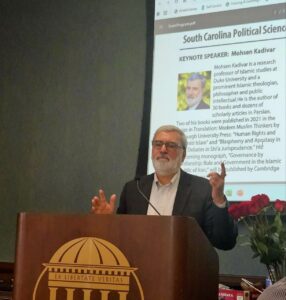
The US-Israel War Against Iran and Iran’s Internal Conflicts

Keynote Address — 2026 South Carolina Political Science Association Annual Conference: This illegal, unconstitutional, and unjust war must end immediately — with a non-aggression agreement that includes adequate guarantees against any renewed aggression toward Iran. Iranians stand firmly opposed to religious despotism, yet simultaneously support their Army in defending their homeland against foreign aggression. Popular solidarity in defense of the nation — including a broad willingness to defer domestic opposition to the Islamic Republic — has increased markedly. Ultimately, this military aggression has weakened and set back Iran’s freedom-seeking, democracy-demanding movement.

Iran at a Crossroads: Protests and Political Futures

The Islamic Republic bears direct responsibility for the bloodshed, and its Supreme Leader is the principal accused. Opponents of the Islamic Republic can be divided into two groups. The national opposition adheres to three core principles: non-intervention by foreign powers, rejection of domestic tyranny, and a peaceful, democratic transition away from the Islamic Republic. According to the second type of opposition, the Islamic Republic must be overthrown at any cost—even through foreign intervention, and internal armed conflict. A referendum on the constitution of the future system must be held.

“We don’t need a Supreme Leader”

Kadivar evaluates the future of Iran, characterizing the current authoritarian theocratic regime as a failing state that has lost its popular legitimacy. While he acknowledges the government’s continued resilience against immediate collapse, he argues that ‘systemic reform’ or a transition to a secular democratic republic is essential for the nation’s survival. Condemning any foreign aggressions, Kadivar emphasizes that the recent illegal Israel-US attacks have temporarily bolstered Iranian nationalism, while true stability requires the abolition of the Supreme Leader’s office. A national referendum allows citizens to choose between various political models.

Iran: The Domination of a Minority Over a Diverse Society

The back-breaking U.S. sanctions impact the lower classes far more than the theocratic regime or the IRGC. The major problem in Iran is the domination of an ideological minority over a diverse society. While the regime pours resources into regional ambitions, domestic discontent grows, poverty, repression, and a generation that rejects the politicization of religion. Most Iranians today overwhelmingly prioritize national interests. Palestinians have the right to their land, their country, and their sovereignty. U.S. military aid to Israel has been used to support acts of genocide and ethnic cleansing.