
DER SPIEGEL, No. 4, January 16, 2026, pp. 54-57
“Wir brauchen keinen obersten Führer”
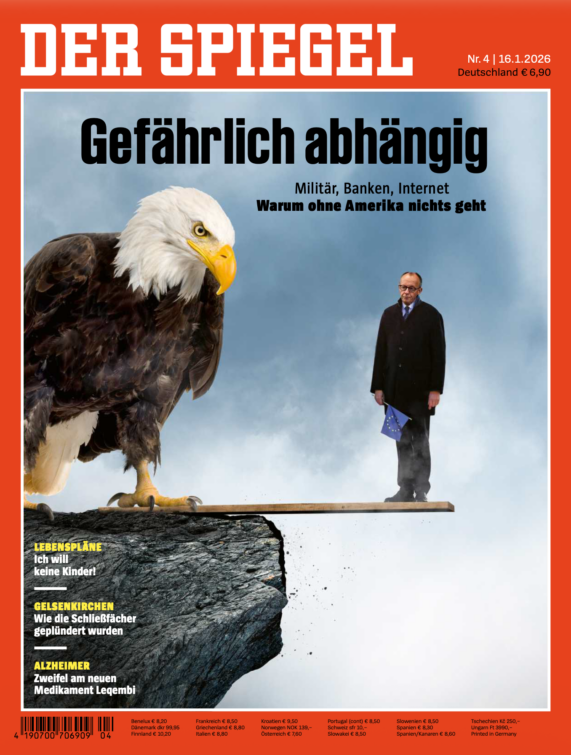
Mohsen Kadivar on Iran’s future
“We don’t need a Supreme Leader”
Ayatollah Mohsen Kadivar, who teaches in the US, doubts that Iran’s regime is on the verge of collapse. Nevertheless, he considers the Islamic Republic to be a failure. He proposes an alternative.
Ayatollah, philosopher, and theologian Mohsen Kadivar, 66, originally from Iran, has been researching and teaching at Duke University in Durham, North Carolina, for 17 years. His office is located in the Department of Religious Studies, where Kadivar’s books stand alongside those of Christian and Jewish scholars in a display case in the hallway. Kadivar is a staunch critic of the regime in Tehran and has been advocating for democratic reforms for years, so again now, since the beginning of the latest wave of protests in Iran. Unlike other representatives of the Iranian exile community, the theocratic leadership cannot simply dismiss Kadivar as a “Westernized” critic. He is himself a high-ranking Shiite cleric. This makes him a sensitive opponent for the regime.
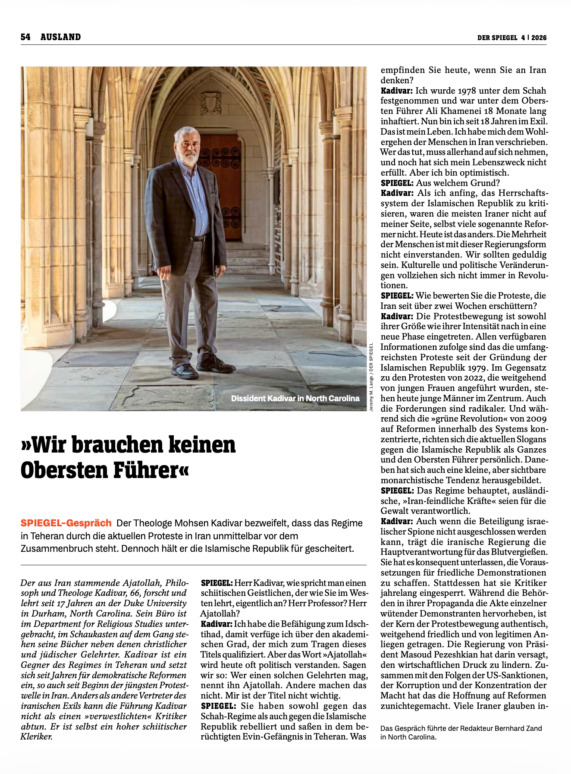
SPIEGEL: Mr. Kadivar, how does one actually address a high-ranking Shiite theologian who teaches in the West? Professor? Ayatollah?
Kadivar: I have the degree of ijtihad that qualifies me to bear this title. But the word “ayatollah” is often understood politically today. Let’s put it this way: Those who like such a scholar call him Ayatollah. Others do not. The title is not important to me.
SPIEGEL: You opposed both the Shah’s regime and the Islamic Republic and were imprisoned in the notorious Evin Prison in Tehran. What do you feel today when you think of Iran?
Kadivar: I was arrested in 1978 under the Shah and was imprisoned for 18 months under Supreme Leader Ali Khamenei. I have now been in exile for 18 years. That is my life. I have dedicated myself to a sacred cause, the humanities, the national interest, and the welfare of the people of Iran. Anyone who does that should be ready to bear something like that, and I have not yet reached my life’s purpose. But I am optimistic.
SPIEGEL: Why is that?
Kadivar: When I began criticizing the Islamic Republic’s system of government—vilayet-e faqih, the guardianship of the jurist—most Iranians did not agree with me, including many reformers. Today, things are different. The majority disagrees with this type of government. We should be patient. Cultural and political changes do not always come about through revolutions.
SPIEGEL: How do you assess the recent protests in Iran – and the extreme violence with which the regime has been attempting to suppress them?
Kadivar: The protest movement has entered a new phase in both scale and intensity. Based on available videos, it appears comparable to—and possibly larger than—the 2009 movement, making them the most extensive protests since 1979. Unlike the 2022 protests, which were largely feminist and led by young women, the current movement is predominantly male, with young men at its center. The demands are also more radical. Whereas the 2009 protests focused on constitutionalism and reform within the system, recent slogans openly target dictatorship, the Islamic Republic as a whole, and the Supreme Leader personally. A minor but visible monarchist tendency has also emerged alongside these demands.
SPIEGEL: As in the past, the regime claims that foreign forces, hostile to Iran, are responsible for the violence.
Kadivar: While the potential involvement of Israeli spies in inciting violence cannot be dismissed, the government bears primary responsibility for the bloodshed. It has consistently failed to provide the conditions necessary for the peaceful demonstrations guaranteed by the constitution and has kept influential critics under house arrest or in long-term imprisonment for years. While the authorities highlight these actions in their propaganda, the core of the movement remains genuine, popular, largely peaceful, and rooted in legitimate grievances. The Pezeshkian government’s failure to address crises of economic pressure and poverty—combined with U.S. sanctions, mismanagement, structural corruption, and the concentration of power in an authoritarian leadership—has extinguished public hope for reform. Many Iranians now believe the Islamic Republic is incapable of solving the country’s fundamental problems. While there is broad agreement on what people reject, there is no consensus on alternatives, underscoring the need for a referendum and increasing vulnerability to foreign manipulation.
SPIEGEL: Some observers are again predicting the imminent fall of the regime; others are more cautious. Where do you stand on this issue?
Kadivar: There is insufficient evidence to support claims of the regime’s imminent collapse. It can be asserted with confidence that, although the Islamic Republic has been significantly weakened and its legitimacy severely eroded, it continues to function as an authoritarian, revolutionary, electoral regime. Based on the most recent presidential election, roughly fifteen percent of the population still actively supports it. Another indication is the nationwide demonstrations held today, January 12, in support of the government and against the so-called rioters. As long as the system retains the backing of the IRGC and the militia (Basij), and there are no signs of a split within the army, a sudden collapse is highly unlikely. There is also no organized opposition enjoying majority support. Crucially, the state has not yet deployed the full extent of its coercive capacity. Iran’s situation differs fundamentally from Libya, Iraq, Syria, and Venezuela.
SPIEGEL: US President Trump threatened that „help is on the way “ for the protesters, even saying that the US is „locked and loaded and ready to go“. What do you think of such claims and statements?
Kadivar: President Trump’s statements can be assessed through the lenses of realpolitik and international law. From a realpolitik perspective, the United States often acts as a dominant global power seeking to impose its will without regard for international as we have seen recently in Venezuela. From the standpoint of international law, however, such behavior constitutes clear violations of the UN Charter and the principle of non-interference. Trump’s statements on Iran follow this pattern and amount to unlawful interference in another country’s internal affairs. Despite his unpredictability, a direct military attack on Iran appears unlikely. Most Iranians, despite deep opposition to the Islamic Republic, would defend their country against foreign aggression. A more probable strategy is internal erosion—through sanctions, internal divisions, and obstruction of reform—a dangerous path facilitated above all by the failures of Iran’s own leadership.
SPIEGEL: Do you think you will be able to return to Iran soon?
Kadivar: That depends on many things. The war that Israel and the US waged against Iran has certainly delayed everything. It has not advanced democracy or human rights in Iran. Many in the West, especially many Israelis, do not understand this. They thought an uprising during the war would break out in Iran. That did not happen. Instead, internal cohesion has grown. Even political prisoners and intellectuals under house arrest have condemned the attack on Iran. We in the diaspora have done the same: fifteen colleagues and I, all staunch opponents of the regime, have publishedtwo statements in which we expressed our unconditional support for our country.
SPIEGEL: What was your main criticism of Israel’s and the United States’ attacks on Iran?
Kadivar: Israel attacked Iran militarily while Iran and the United States were negotiating; in fact, it was intended to stop the Iran-U.S. negotiations. The United States also bombed Iran’s nuclear facilities during talks. The military actions of both countries against Iran violated international law. Yet, the European Union has not condemned Israel’s aggression, and the German Chancellor even stated that “Israel is doing the dirty work on our behalf.” It may well be that the Islamic Republic has failed in Iran. But liberal democracy in the West has also faced a severe defeat after Israel’s brutal attacks on Gaza and Iran. International law, proclaimed humanitarian rights, ethics, and the United Nations have become empty concepts.
SPIEGEL: What did you achieve by expressing your support for Iran?
Kadivar: On September 25, President Masoud Pezeshkian received me for a private meeting of more than one hour on the sidelines of the UN General Assembly in New York. This was the first time that the Islamic Republic invited one of its structural critics at such a high level to hear his views. Before returning, a senior official from the presidential office met with me and said, ‘Why don’t you come back to Iran? The situation has changed.’
SPIEGEL: What was your response?
Kadivar: I thanked him and replied, ‘What about the critics inside the country who are under house arrest or in prison!?’ Despite close observation of recent developments, I still unfortunately do not see any real indication that the regime is returning to the people. Two examples: I explained to him that I have been completely banned from publishing in my own country since 2009. Yet, just a few days after releasing the news of the meeting, Kayhan—a hardline newspaper aligned with the Leader of the Islamic Republic—launched a harsh attack on this very meeting and labeled me a hostile figure. I genuinely do not understand why Iran’s rulers remain so resistant to meaningful structural reforms.
SPIEGEL: Did the so-called Twelve-Day War of June 2025 ultimately strengthen or weaken the regime?
Kadivar: Both. The attack exposed major weaknesses, including in infrastructure and the secret services. But at the same time, the regime was also strengthened. Because this attack came from outside. Believe me: a change in Iran from outside is out of the question.
Mohsen Kadivar was born in 1959 under the rule of Shah Mohammed Reza Pahlavi and grew up in the central Persian city of Shiraz. In the early 1960s, the Shah, who had close ties to the US and Israel, began to modernize and westernize Iran – against the resistance of the Shiite clergy, whom the Shah persecuted with increasing severity.
Kadivar had just begun studying electrical engineering when the first major protests against the Shah’s regime broke out. In early 1978, several people were killed during a demonstration in support of Ayatollah Ruholla Khomeini, who was living in exile. In accordance with Shiite rites, 40 days later, there were nationwide mourning rallies, which again resulted in deaths and injuries – a cycle that was to repeat itself every 40 days. In May 1978, Mohsen Kadivar was arrested at one such demonstration by the Iranian security service, the notorious Savak.
SPIEGEL: What memories do you have of your first arrest?
Kadivar: We had gathered in a mosque, and when we came out, someone grabbed me from behind. I knew immediately: it was the Savak. I was the first and youngest person to be arrested that day. In prison, they first shaved my head, then set a trial date. Until that date, however, I was released on bail, which my father posted.
SPIEGEL: Was that possible under the Shah?
Kadivar: I was lucky. US President Jimmy Carter was urging the Shah to show restraint during those months. In any case, that night in prison was a very formative experience for me. Somehow, I was even proud that my picture was published alongside those of the other detainees. I remember showing my fellow students my shaved head. If I had been arrested a few months earlier, I would probably have been imprisoned for two years. As it was, the sentence was 100 days in prison, which I was able to defer for 300 tomans per month. I paid this fee for three months, then I stopped paying the fee, because the revolution broke out.
On January 16, 1979, the Shah gave in to pressure from his opponents and left Iran. Shortly afterwards, Ayatollah Khomeini returned from exile to Tehran and seized power. Within weeks, hundreds of representatives of the old regime were executed, with thousands more to follow. On April 1, Khomeini proclaimed the Islamic Republic, and in December, a new constitution came into force, guaranteeing the “Supreme Leader” extensive control over the government, parliament, and judiciary.
In September 1980, Iraq’s dictator Saddam Hussein launched a war against Khomeini’s regime. This war was to last eight years and cost hundreds of thousands of lives. Saddam’s expectation that his attack would lead to the collapse of the Islamic Republic did not come to pass. Instead, the Iran-Iraq War consolidated the form of government shaped by Khomeini and still in force today, the “guardianship of the jurist.” Deeply religious, Mohsen Kadivar did not finish his engineering studies and started his studies at the seminary in Shiraz.
SPIEGEL: Saddam Hussein’s attack in 1980 united the population and the leadership. Did that also apply to the Israel-Iran war last June?
Kadivar: Yes, but there is a big difference. Back then, people were not only loyal to their leader but also willing to sacrifice themselves for their religion, their revolution, and their country. Today, only the last of these points, Iranian nationalism, dominates. Regardless of whether they like the regime or not, people are primarily concerned about their country. Almost all Iranians felt that Israel’s attack was unjust, and almost all agree that this war was forced upon them. A minority accuses the regime of not doing enough against Israel. And an even smaller minority blames the regime itself for the war.
SPIEGEL: But is that enough for the regime to stay in power?
Kadivar: Only if there are reforms. I have made a few suggestions, all of them pragmatic and within the framework of the current Constitution: Release the political prisoners. Lift the house arrest on your opponents. Allow more freedom of the press, political parties, and NGOs, and freedom of peaceful demonstration. Today, the only media outlet in Iran that sets the tone is the newspaper “Keyhan”, a hardline publication. Change that! At least switch to the line taken by “Etelaat”. That is also a government newspaper, but a somewhat more moderate one. That is my first scenario: if the regime wants to remain in power, it must at least enact these minimal reforms.
SPIEGEL: What is your other scenario?
Kadivar: That concerns the Supreme Leader, Khomeini’s successor Ali Khamenei, who has been in power since 1989. Here is my suggestion: relinquish some of your power. According to Article 110 of the Iranian constitution, the Supreme Leader is free to cede some of his eleven rights and duties—for example, to the elected president or to his successor. But what probably happened is ceding to the commanders of the IRGC…
SPIEGEL: …the regime’s praetorian guard, which already controls large parts of the military and the economy.
Kadivar: But there is a third scenario – the resignation of the Supreme Leader. This case is also regulated in the Constitution. Should it occur, the Assembly of Experts must appoint a successor. Until that happens, a committee consisting of the president, the chief justice, and a jurist member of the Guardian Council will govern. This committee would also have the power to hold a referendum, but it would have to be on a fundamental change to the political system.
For sixteen years – not unusual for high-ranking Shiite clerics – Mohsen Kadivar studied theology, philosophy, and Islamic law, first in Shiraz, then in the scholarly city of Qom. His mentor was Grand Ayatollah Hossein-Ali Montaseri, who was considered the designated successor to Ayatollah Khomeini until shortly before the latter died in 1989. But like his famous mentor, Mohsen Kadivar also distanced himself from the leadership under the impression of serious human rights violations. When he compared the Islamic Republic to the absolutist Shah regime in early 1999, he was sentenced to 18 months in prison “for spreading lies, and propaganda against the Islamic Republic.“ A preacher of the revolution became one of the regime’s most eminent critics.
SPIEGEL: So you are proposing to let the Iranian people decide on the future of their country in a referendum. What exactly would you put to a vote in such a referendum?
Kadivar: Four options that cover the entire political spectrum of our country. The first of these is the continuation of the current Constitution, meaning absolute guardianship of the jurist. Even if the number of supporters of this solution will be small, certainly no more than 20 percent, these hardliners are also Iranians. We cannot ignore them. But they should recognize, in a fair referendum, that they have long since lost their majority.
SPIEGEL: What is the second option?
Kadivar: That is the constitution that was originally drafted in 1979: an Islamic republic, but one that is governed not by a jurist, but by an elected president. Even Ayatollah Khomeini initially agreed to this Constitution draft. I believe that many Iranian reformers would support such a Constitution draft today.
SPIEGEL: And option number three?
Kadivar: That would be the Constitution of 1906: a constitutional monarchy, similar to today’s United Kingdom. There are certainly people in Iran who can imagine bringing back the pre-revolutionary regime.
SPIEGEL: Crown Prince Reza, born in 1960, who, like you, lives in exile in the United States and offered himself as a figure of political transition.
Kadivar: Remember that many constitutionalists who defended his father now oppose Reza Pahlavi. I don’t think the majority would support such a solution. But if they believe they can convince other Iranians, then they should be given that opportunity.
SPIEGEL: That leaves option four.
Kadivar: That’s the option I support: a democratic republic, a secular regime. As a practicing Muslim, as a theologian and a legal scholar, I am opposed to philosophical secularism, because that is ultimately atheism. But in politics, I am secular and in favor of the separation of state and mosque. And I know that many who were once called reformers, many of whom are now in prison or under house arrest, think exactly as I do.
SPIEGEL: Is there a specific state you have in mind as a role model?
Kadivar: Basically, any secular state. To stay in the region, think Turkey and Tunisia, for example. Or take the Iraqi Constitution, which was drafted after the American invasion in 2003. What matters to me is the separation of state and religious institutions: the end of the “guardianship of the jurist,” which has proven to be a historical mistake. Whether this ultimately leads to another Islamic republic or a democratic republic of Iran is up to the Iranian people to decide.
SPIEGEL: The Iranians have elected reformers to the presidency twice, but Mohammed Khatami and Hassan Rouhani have both disappointed them. Barely half of those eligible to vote took part in the last presidential election. Is there any person, or a group of personalities, who would have the charisma to carry out such a profound reform as you have in mind?
Kadivar: Mir Hossein Mousavi, the former prime minister who has spent more than 15 years under house arrest, and Mostafa Tajzadeh, who has been a political prisoner for 10 years, would both have a strong chance of winning in a free presidential election. They share my views in supporting a referendum and somehow a secular, democratic government. The era of charismatic leaders is over. Iran had enough of that 50 years ago. We do not need such a person. We do not have to have a “Supreme Leader” anymore. We need a democratic republic, and I believe most Iranians see it that way too. For many of them, Islam will always remain a central part of their lives. And theologians like me can ensure that we have a democratic, secular Iran—and still preserve our Islamic values.
Republished at Duke Islamic Studies Center Website