

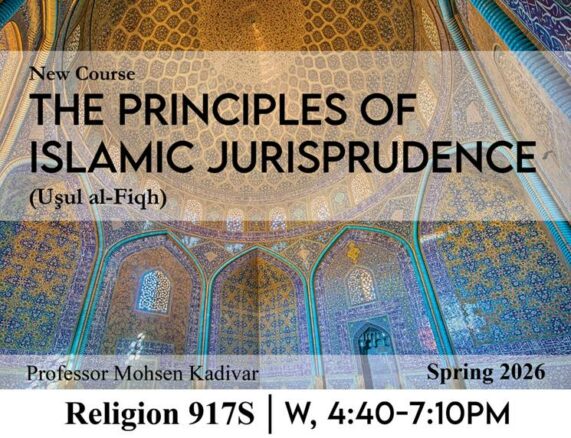
RELIGION 917S
The Principles of Islamic Jurisprudence
(Uşul al-Fiqh)
Mohsen Kadivar, PhD
Spring 2026
W, 4:40-7:10 pm
Course Description:
The principles of Islamic jurisprudence (uṣūl al-fiqh), or Islamic legal theory, constitute one of the most important fields in Islamic studies. While traditionally serving as an introduction to jurisprudence (fiqh), their scope is far broader. As the name suggests, this discipline originated as a set of principles, theories, and methods for jurisprudential inference, which gradually developed and expanded over time. In most Islamic legal schools, students study the principles of jurisprudence before engaging in substantive jurisprudence itself. The discipline is generally divided into at least four main sections:
1. Language and Meaning (mabāḥith al-alfāẓ): This section examines how religious texts—primarily the Qur’an and the Sunnah of the Prophet as transmitted through ḥadīth—convey meaning. These discussions are not limited to Arabic; their rules apply to any language. In its traditional form, Language and Meaning in uṣūl al-fiqh is highly advanced, comparable in rigor to discussions in formal logic, and resonates with modern debates in hermeneutics, semantics, linguistic philosophy, and the philosophy of language. Comparative study between traditional Islamic jurisprudential principles and these modern disciplines yields valuable insights that transcend any single language, offering essential tools for the accurate interpretation of all forms of textual meaning.
2. Rational Correlations (al-mulāzimāt al-ʿaqliyya): This section covers two major topics. The first, Rational Non-Autonomies (ghayr al-mustaqillāt al-ʿaqliyya), asks: What rational implications accompany a textual or linguistic proposition? In other words, when a narrational statement appears in a text, what logical consequences are implicitly intended alongside it? The second, Rational Autonomies (al-mustaqillāt al-ʿaqliyya), explores whether rational premises alone can yield religious rulings. Put differently: In which matters can human reason independently discern right from wrong without recourse to revelation? This is the classic debate over the rational good and evil (al-ḥusn wa al-qubḥ al-ʿaqliyyān), a topic that has divided Muslim scholars since the second Islamic century. Beyond its role in jurisprudence, this discussion has significant implications for ethics and the philosophy of law.
3. Authority or Probativity (ḥujjiyya): This section asks: From which sources can religious rulings be derived? How is the validity of these sources established? In what way do they provide knowledge, certainty, or supposition (ẓann)—and if supposition or probability, why is it acceptable? It addresses the authority of Qur’anic verses, single-source reports (al-khabar al-wāḥid), consensus (ijmāʿ), rational evidence, apparent linguistic meanings (ẓawāhir), rational and religious practice (sīra), custom (ʿurf), analogy (qiyās), juristic preference (istiḥsān), public interest not explicitly mentioned in texts (maṣāliḥ mursala), blocking means that could lead to harm (sadd al-dharāʾiʿ), and Shariah objectives (maqāşid al-shari’a). Two important appendices to this section, with considerable practical utility, are the discussion of Balance and Preference (taʿādul wa tarājīḥ), which offers methods for resolving conflicts between pieces of verbal evidence, and ijtihad and imitation (taqlīd). The issues explored here are closely connected to theological, philosophical, and ethical debates.
4. Procedural Principles (al-uṣūl al-ʿamaliyya): This section provides guidance when no clear religious proof exists, focusing on doubt (shakk) regarding a legal ruling. In such cases, four possible approaches may apply: Presumption of Continuity (istiṣḥāb), Exemption (barāʾa), Engagement (ishtiġāl) or Precaution (iḥtiyāṭ), and Optional Choice (takhyīr). It examines the precise conditions for implementing each. These frameworks are not limited to legal uncertainty; they are relevant to doubt in any domain.
A survey of these discussions reveals that uṣūl al-fiqh is far more than a prologue to jurisprudence. It is an essential foundation for all Islamic narrative sciences, including Qur’anic interpretation and sciences, ḥadīth studies, history and biography (sīra), narrative theology (kalām naqlī), and narrative ethics (akhlāq naqlī). Without familiarity with the principles of Islamic jurisprudence, it is impossible to offer a sound interpretation or judgment within any of these fields.