

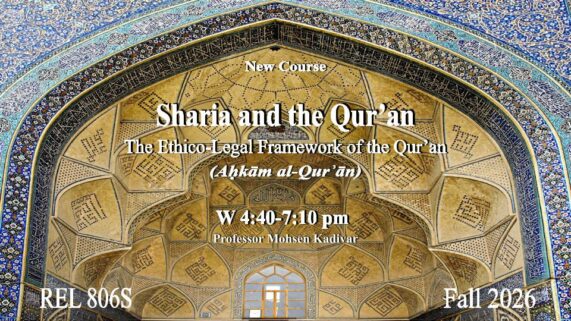
RELIGION 806S
Sharia and the Qur’an:
The Ethico-Legal Framework of the Qur’an
(Aḥkām al-Qurʾān)
Seminar
Mohsen Kadivar, PhD
Fall 2026
Wednesdays, 4:40-7:10 pm
Course Description:
The course examines Sharia—the Qur’an’s ethical and legal frameworks—through primary sources. It thematically and chronologically analyzes verses on morality, ritual, and human interaction. Students explore the Aḥkām al-Qurʾān genre across legal schools in original languages using a holistic, historical-critical approach. Alongside jurisprudence, the course delves deeply into Qur’anic morality and the ethical implications of key terms such as mercy, justice, fairness, and dignity, emphasizing the Qur’an’s enduring ethical and legal principles.
Aḥkām al-Qurʾān is a term used in jurisprudence and Qur’anic studies to denote the legal injunctions of the Qur’an. Verses that contain such rulings are referred to as Aḥkām al-Qurʾān—“verses of rulings.” Since the early centuries of Islam, coinciding with the formative period of Islamic scholarship, these verses have been a shared focus of jurists and exegetes. Works on the jurisprudential rulings of the Qur’an have appeared under various titles, such as Aḥkām al-Qurʾān, Āyāt al-Aḥkām, Fiqh al-Qurʾān, and Sharḥ Āyāt al-Aḥkām. Generally, Sunni authors have preferred the title Aḥkām al-Qurʾān, while Shi‘i scholars have more frequently used Āyāt al-Aḥkām or Sharḥ Āyāt al-Aḥkām.
Structurally, the Aḥkām al-Qurʾān works are typically organized according to the order of surahs and verses. In contrast, Fiqh al-Qurʾān and Sharḥ Āyāt al-Aḥkām tend to follow a thematic or jurisprudential order. From this genre, several significant works have survived from the ninth century onward within the Mālikī, Shāfiʿī, and Ḥanafī schools, some of which remain authoritative to this day. This course critically examines the most influential of these texts, analyzing both their legal and moral dimensions within the broader Qur’anic framework.
This course aims to familiarize students with the Qur’anic foundations of jurisprudence and to develop their ability to derive legal rulings from divine revelation through the approaches of jurists and exegetes. Students will critically engage with the limitations of atomistic, dogmatic, and ahistorical interpretations. They will learn to apply holistic and historical-critical methods that examine all related verses collectively and contextually.
Through the thematic method of Qur’anic jurisprudence, students will recognize that certain legal rulings—such as the worldly punishment of apostasy or blasphemy—lack a Qur’anic basis and contradict the Qur’an’s affirmation of religious freedom. Similarly, they will explore how punishments like stoning have no Qur’anic support, and how patriarchal interpretations reflect the biases of male commentators.
The course encourages students to adopt a gender-egalitarian and morally grounded reading of the Qur’an that upholds its central ethical principles—human dignity, mercy, justice, and fairness—in all jurisprudential reasoning.